AI in Trade Show OrganizationOctober 17, 20266 min read
AI Agent in the Exhibitor Portal: How It Recommends the Right Power Connection to Exhibitors
Exhibitors know their devices, but not the matching connection in the catalog. An AI agent in the exhibitor portal asks, retrieves the organizer's guide values, takes the rule from the info sheet and proposes a cart that the exhibitor confirms.
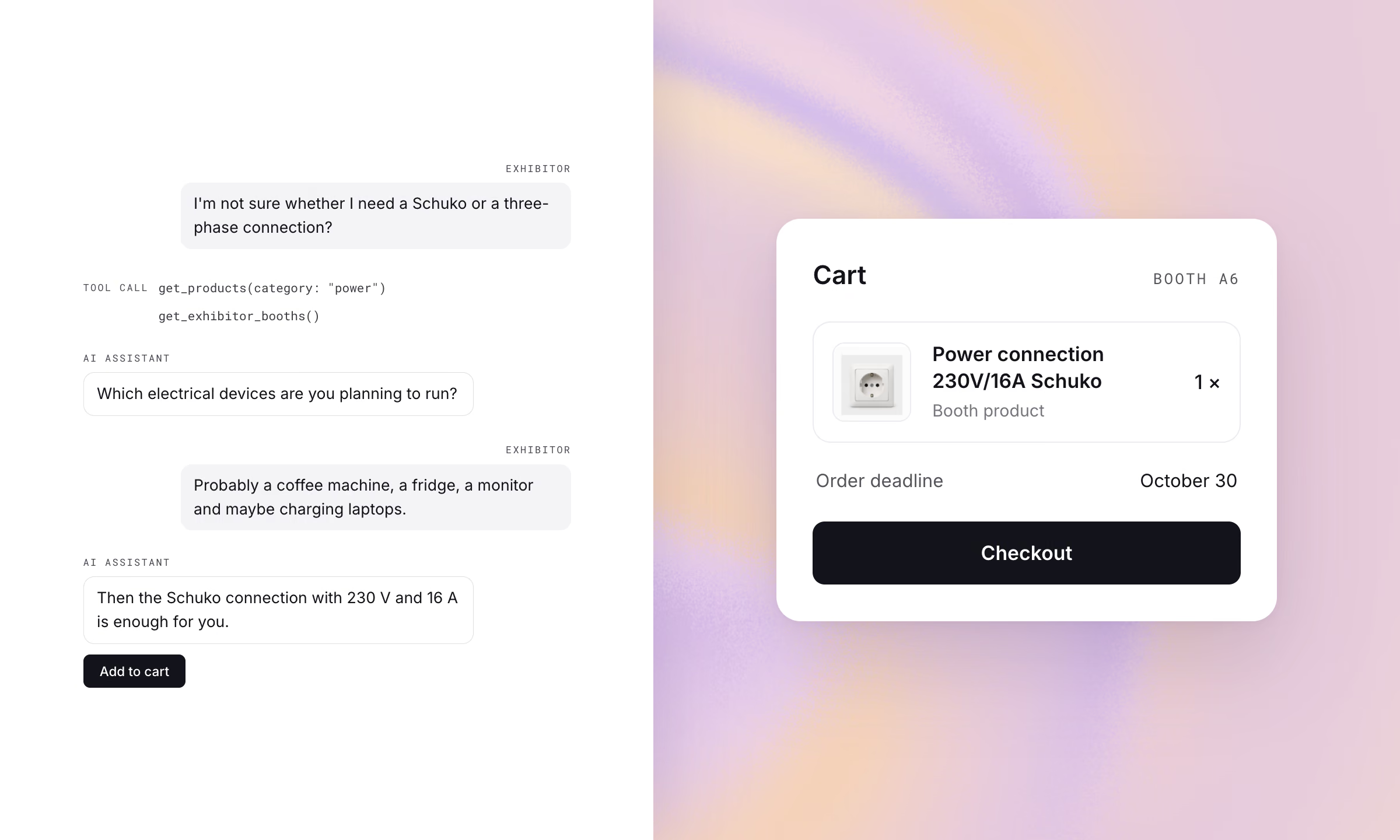
An AI agent in the exhibitor portal recommends the right power connection by asking the exhibitor about their devices, retrieving the organizer's recommendation from the organizer's guide value table via a tool and finding the matching connection in the catalog. It takes rules such as overnight power from the info sheet via document search, and last year's order via tool call. The result is a proposal for the cart that the exhibitor confirms.
This article walks through the flow step by step and describes what organizers provide for it. When an agent is worth it at all is covered in the overview of AI agents in trade show organization.
As of October 2026: exhibitors can already ask the chat in the Fairoo exhibitor portal questions about their own data. The advice flow shown here, with the guide value table and proposal buttons, is the next development step. All data in the example is fictitious: Trade Show 2026, booth A6, deadline October 30.
Why the power connection
Power is a typical case for an agent: an unstructured request meets a structured system. Exhibitors know which devices they bring, but hardly anyone knows how many kilowatts a coffee machine draws or when a standard Schuko socket with 230 V is no longer enough. The catalog, in turn, only knows connections with voltage, fuse rating and price. In the weeks before the show, exactly these questions land with the exhibitor services team, often together with the tenth reminder about open tasks.
An agent closes this gap like a concierge with whom the exhibitor works through their preparation. Where they exist, it bases its recommendation on the data and rules of the specific event.
The advice flow in four steps
| Step | What the agent does |
|---|---|
| 1. Open tasks | The exhibitor asks what still needs to be done before the show. The agent retrieves the open tasks and knows who is asking from the login. Result: the task “Power connection”, due October 30, with the buttons “Open power connection shop” and “I don't need a power connection”. |
| 2. Follow-up question | The exhibitor asks whether the Schuko connection will be enough again, since a coffee machine is coming along this year. The agent fetches the catalog and last year's order (Schuko connection and 24-hour socket). The machine's power draw is in no system, so it asks: household appliance or catering machine, and which other devices will run? |
| 3. Recommendation | The exhibitor names an office bean-to-cup machine, a small fridge, a monitor and two laptops. The model maps the devices to entries in the guide value table, a tool retrieves the organizer's recommendations, and document search finds the overnight power rule in the info sheet. Proposal: “Add 2 items to cart”. |
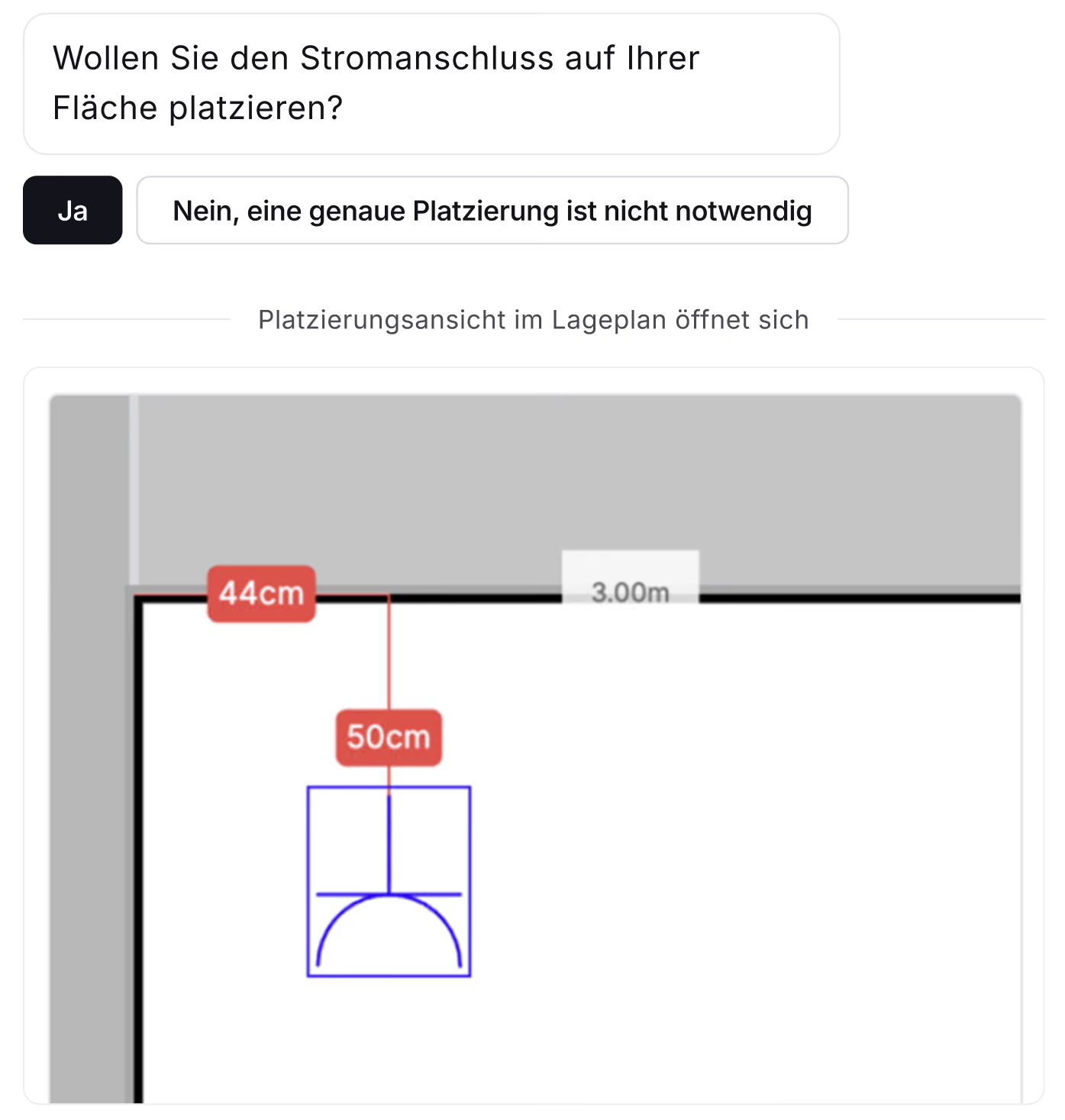
| 4. Placement | After confirmation by the organizer, the task “Position of power connection” is open. The agent links to the layout editor with a button. |
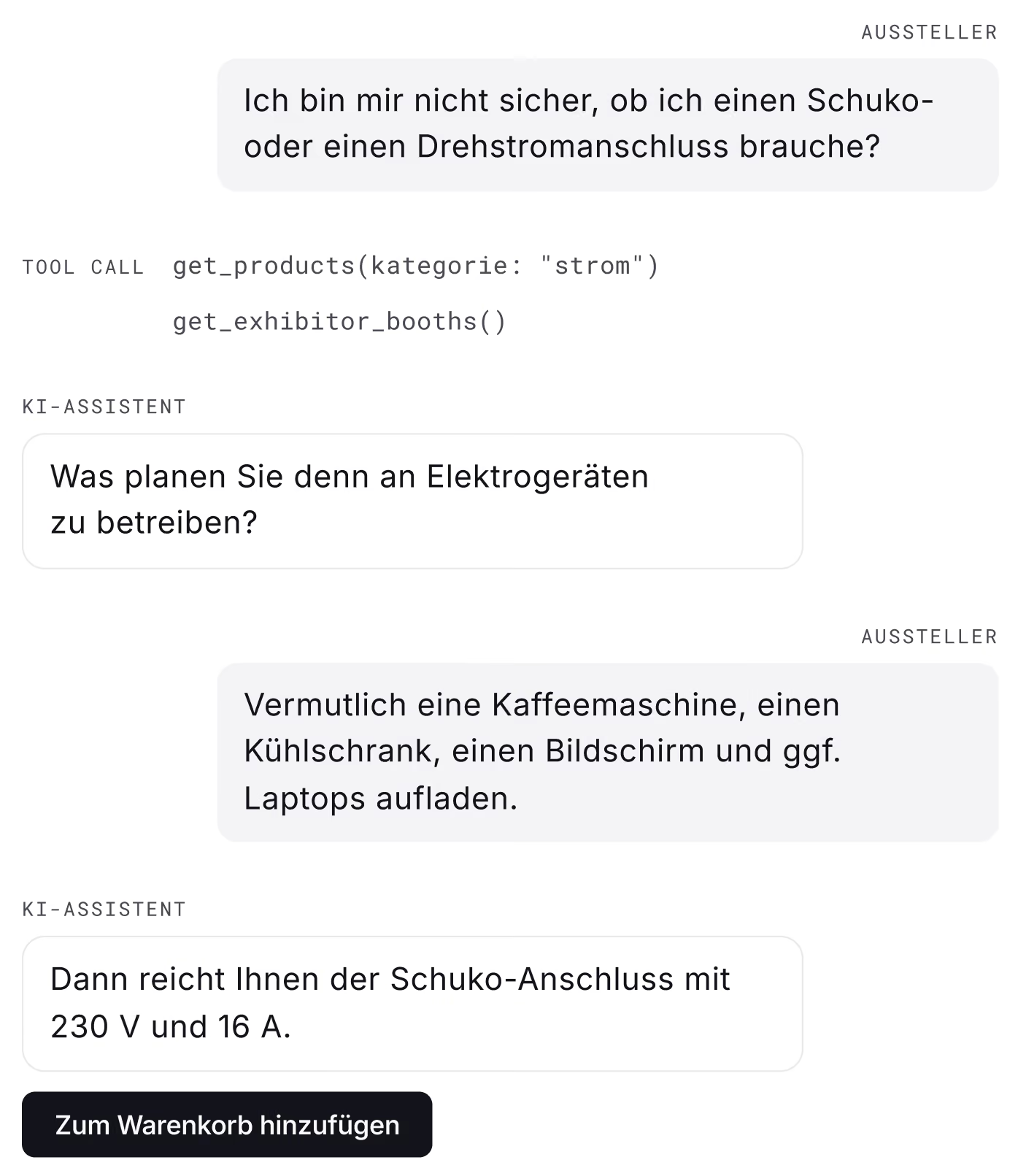
The recommendation from step 3 in the demo flow: “Based on your trade show's guide values, the Schuko connection with 230 V and 16 A is enough again for an office bean-to-cup machine, a small fridge, a monitor and two laptops. The rating plate of your devices is what counts. The booth lighting is not included. For the fridge, I recommend the 24-hour socket as last year, because booth power is switched off after the show closes.”
Source, assumptions and exclusions are part of the answer. The exhibitor can trace and correct every detail before putting anything in the cart.
Where the recommendation comes from
The recommendation does not come from the language model's knowledge. Each subtask has its own source, and only one of them is the model.
| Subtask | Who handles it, and with what |
|---|---|
| Mapping devices | Language model: “a normal bean-to-cup machine from our office” becomes the row “bean-to-cup coffee machine”, not “commercial espresso machine” |
| Retrieving guide values | Tool: retrieves the organizer's recommendation from their guide value table |
| Proposing a connection | Catalog: the product the recommendation points to, with the power rating stored on the product |
| Event rules | Document search in the power info sheet, for example on overnight power and order deadlines |
| Previous year | Tool call to the order history of the logged-in exhibitor |
What goes into the guide value table is up to the organizer: which devices get by with which connection and when three-phase power is needed. The agent does not calculate anything itself, it relays the organizer's recommendation. Trade fair companies publish reference points for such tables themselves. Messe Frankfurt, for example, lists guide values such as 1.5 kW for a coffee machine and 0.8 kW for a fridge in an info sheet (How to Kilowatt berechnen, in German, accessed October 2026). How much power a connection actually delivers is set by the venue's technical guidelines.
Why the agent discloses its assumptions
Small details decide the recommendation: whether the coffee machine is an office bean-to-cup model or a catering machine, whether the booth lighting runs on the same connection, whether the fridge has to run overnight. That is why the agent asks exactly these questions and states in its answer what it assumes and what it has left out. If an assumption is wrong, the exhibitor sees it right away and can correct it.
When a device is not in the table
Even without a matching entry, the agent can give a recommendation, based on general reference values for the power draw of devices. These are often useful but not backed by the organizer, and for devices with a wide range, such as coffee machines, they can be off. The agent therefore labels such a recommendation as an estimate, states its assumption along with the advice to check the rating plate, and offers to pass the question on to the exhibitor services team.
Product text versus guide value
In the sample catalog, the three-phase connection describes its use as “medium loads such as refrigeration units, coffee machines or demonstration machines”. An agent that only reads the product description would recommend three-phase power because of the coffee machine. The organizer's guide values point to Schuko. Only the table turns a textual similarity into a reliable recommendation. For organizers, this leads to a simple tip: product texts for power connections should state the power limit in kW rather than example devices.
Handover to the layout editor
The agent does not settle the position of the connection on the booth space in the chat. It hands over to the floor plan designer via link. There, the exhibitor moves the marker in the floor plan, sees the distances to the booth corner in centimeters and confirms the layer. The agent advises and routes, while the precise input and its validation are handled by the interface built for it.
The exhibitor decides, the system orders
The agent reads on its own but changes nothing. It does not fill the cart, it proposes it via a button. Orders are placed in the regular checkout with price and terms, and clicking “Add to cart” does not yet place an order. Every paid action is therefore preceded by two steps by the exhibitor. How this boundary is secured technically is described in the article on securing AI agents.
What organizers provide for AI-assisted advice
- Guide value table: for each device, the guide value and the recommended connection, as specified by the organizer.
- Catalog with power limits: for each connection, the available power as a separate field, not only in the product text.
- Current power info sheet: rules on overnight power, refrigeration units and order deadlines for the current event. If last year's info sheet is in the index, the agent quotes last year.
- Handover route: a request to the exhibitor services team for cases without a table value.
- Connection to the venue: if power orders run through the venue's system, the agent advises and hands over via link or interface.
Conclusion
For exhibitors, the hard part is not the rule but the step before it: translating their own devices into kilowatts and mapping them to a catalog. An AI agent in the exhibitor portal takes over exactly this step, through follow-up questions and mapping. Guide values, limits, rules and the order come from the guide value table, the catalog, the info sheet and the checkout, and the decision is made by the exhibitor. Fairoo connects the exhibitor portal, shop and floor plan in one database that such an agent can work on.
Sources
- Messe Frankfurt: How to Kilowatt berechnen. Welchen Stromanschluss benötige ich für meinen Stand? (Which power connection do I need for my booth?) Info sheet with guide values for typical devices, in German, accessed October 2026. messefrankfurt.com (PDF)
Demo
Book a no-obligation intro call
In a short intro call you'll receive trial access and can walk through a process live using one of your own events, with no commitment.
Frequently asked questions
How does an AI agent recommend the right power connection to exhibitors?
It asks about the devices at the booth, maps them to the organizer's guide value table and retrieves the recommendation there via a tool. It finds the recommended connection in the catalog and proposes it for the cart. Source and assumptions are part of the answer.
Where does the AI agent get the power draw of the devices?
From a guide value table maintained by the organizer and from the exhibitor's own information. The language model only determines which device is meant. If a table value is missing, the agent gives a recommendation labeled as an estimate, points to the rating plate and offers to pass the request on to the exhibitor services team.
Can the AI agent order the power connection itself?
No. The agent proposes the items for the cart via a button. The exhibitor confirms the proposal and then orders in the regular checkout with price and terms.
What do organizers need to provide for AI-assisted power connection advice?
A guide value table with devices and recommended connections, a catalog with the power rating of each connection and the current power info sheet for the event. Plus a handover route to the exhibitor services team for devices that are not in the table.