AI in Trade Show OrganizationOctober 15, 20268 min read
AI Agents in Trade Show Organization: Where They Make Sense and Where They Don't
A rule of thumb from practice: agents belong where exhibitors and project managers use everyday language to reach catalogs, tasks and sales data. Deadlines, prices and permissions stay with deterministic software.
An AI agent makes sense in trade show organization wherever unstructured requests meet structured systems. An exhibitor describes in everyday language what their booth needs, a project manager asks a question in a single sentence. Behind both sit the product catalog, tasks, deadlines and sales data. The agent translates between the two sides. Deadline checks, price calculation and permissions remain the job of deterministic software, because there they run faster, cheaper and the same way every time.
Three deep dives belong to this article: AI-assisted power connection advice in the exhibitor portal, the year-over-year comparison in floor space sales and securing AI agents.
Key takeaways:
- Rule of thumb: agents for unstructured requests to structured systems, deterministic software for rule-based processes.
- Context decides: about a specific exhibitor, a language model only knows what is in its context window. Four sources fill it: tool calls, document search, session and follow-up questions.
- Read autonomously, change by click: the agent reads data on its own. Every change is only a proposal that a person confirms.
- Permissions from the login: every tool call runs with the permissions of the logged-in person, never with permissions of the agent's own.
- Five limits: hallucination, binding decisions, hall planning, latency and cost, data quality.
Starting point: AI is widespread, the choice of use cases is open
In the 2025/2026 organizer survey by AUMA, the Association of the German Trade Fair Industry, 70 percent of respondents said they use AI in their own area of work, 14 percentage points more than in the previous year's survey (AUMA and Prognos, October 2025, p. 19, 123 respondents at trade show organizers). The study considers the comparison with the previous year only partly valid, because the samples are not identical. Three areas of work are named most often (p. 20).
| Area of work | Share of respondents |
|---|---|
| Support with texts | 56% |
| Chatbots and virtual assistants | 41% |
| Data analysis | 31% |
Two further findings frame this article. Of 79 assessed AI application fields, the study classifies 44 as “time sinks”, fields with lower potential at higher effort (p. 37), and it names identifying relevant use cases as the central challenge (p. 6). And according to the study, chatbots only deliver their full value once they are connected to CRM systems, matchmaking platforms and follow-up processes (p. 57). The rule of thumb below addresses the first point, the section on context the second.
What an AI agent is, and how it differs from a chatbot
An AI agent is a language model that uses tools in a loop to achieve a goal. The phrasing is common among AI developers: Anthropic described agents in December 2024 as language models that use tools in a loop, and in September 2025 Simon Willison considered it a definition that had become widely enough accepted among AI developers. Tools are functions of your own software with a description and a parameter schema, comparable to API endpoints: list open tasks, query the product catalog, search the technical guidelines. The process has five steps.
- A request comes in.
- The model checks whether the available context is enough for an answer.
- If it is not, the model writes a tool call, meaning a function name and arguments.
- The runtime, the software around the model, executes the call and places the result in the context window.
- The model checks again and returns an answer or a proposal.
The model executes nothing itself. It only writes the call, execution lies with the software.
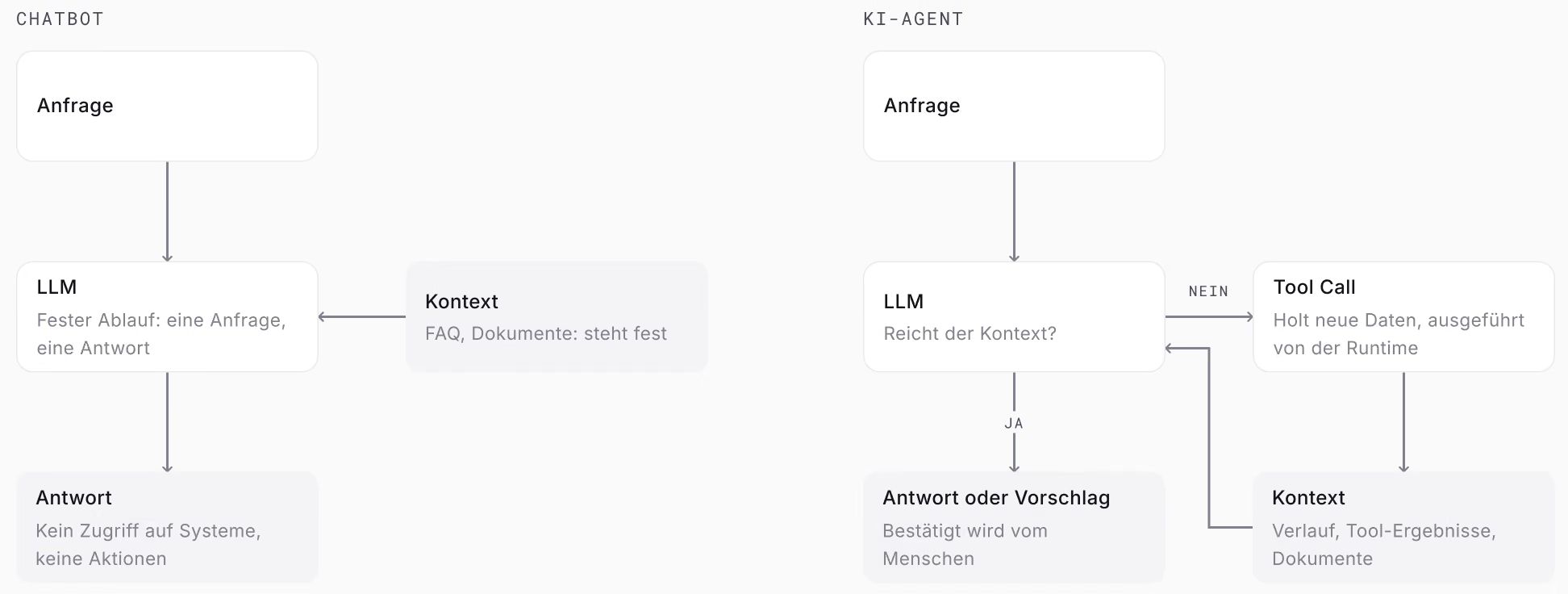
An FAQ chatbot on a trade show website follows a fixed sequence: request, search in FAQ and documents, answer. Its knowledge base is the same for everyone who asks, and systems and actions stay out of reach. For questions about travel, opening hours or the hall plan, that is enough. As soon as an exhibitor asks about their booth, their orders or their deadlines, the answer needs access to exactly that data. In between sits the workflow, in which code defines the order of steps. The distinction from an agent, in which the model controls the process, follows Anthropic.
| Feature | Chatbot versus AI agent |
|---|---|
| Process | Chatbot: fixed, one model call. Agent: controlled by the model, several calls until the context is sufficient. |
| Knowledge source | Chatbot: FAQ and documents, the same for everyone. Agent: documents plus the data of the logged-in person. |
| Same question from two exhibitors | Chatbot: the same answer. Agent: two answers, depending on booth and orders. |
| Actions | Chatbot: none. Agent: proposals as buttons, triggered by the user. |
| Missing information | Chatbot: an answer from the closest passages. Agent: a follow-up question. |
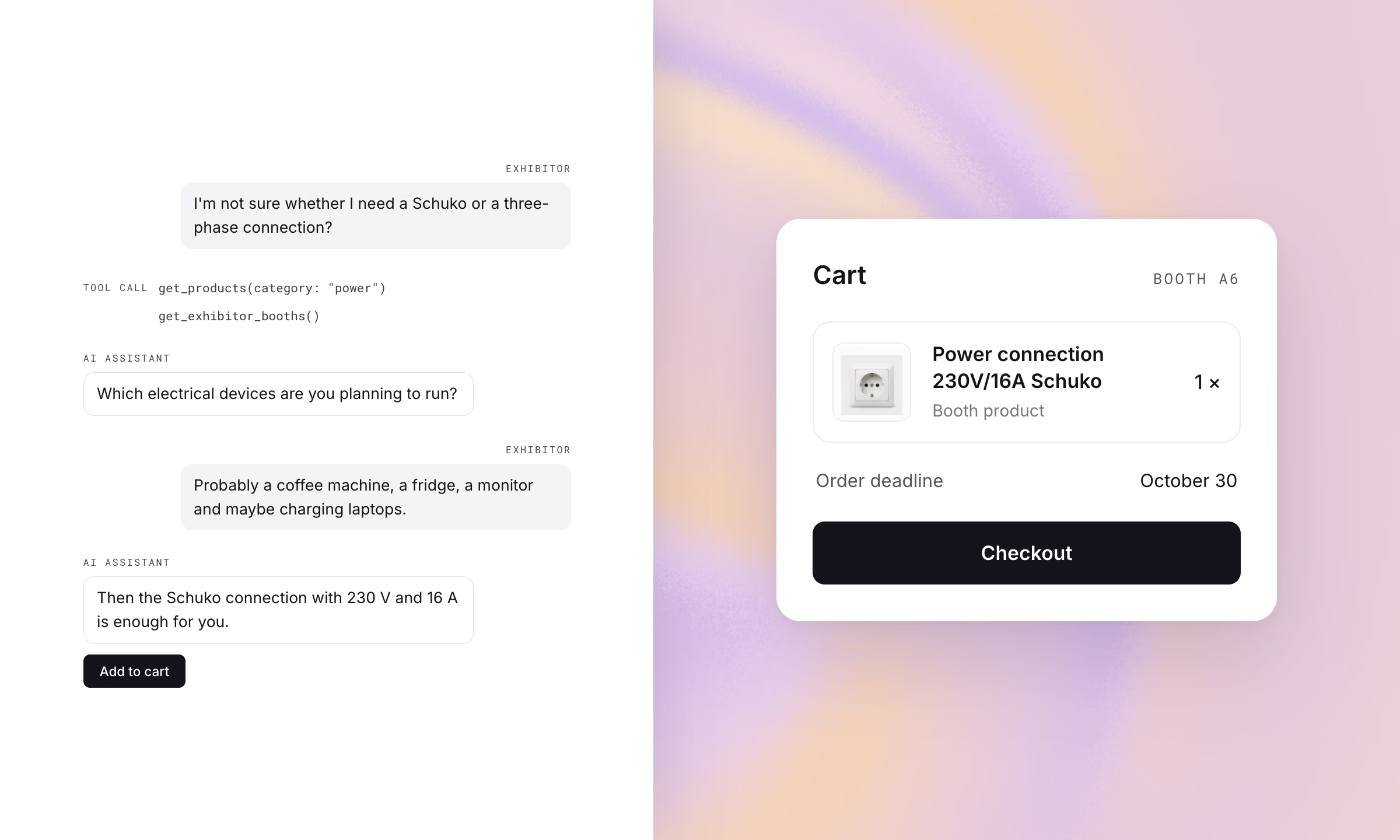
An example makes the difference tangible. An exhibitor writes: “Will the Schuko connection be enough again?” Schuko is the standard 230 V socket in Germany. The word “again” refers to last year's order, and that is in no info sheet. The chatbot explains what a Schuko connection delivers. The agent retrieves the order history, asks which devices will run at the booth and fetches the recommendation from the organizer's guide value table. Both answers are correct, but only one answers the question that was asked.
The rule of thumb: unstructured requests, structured systems
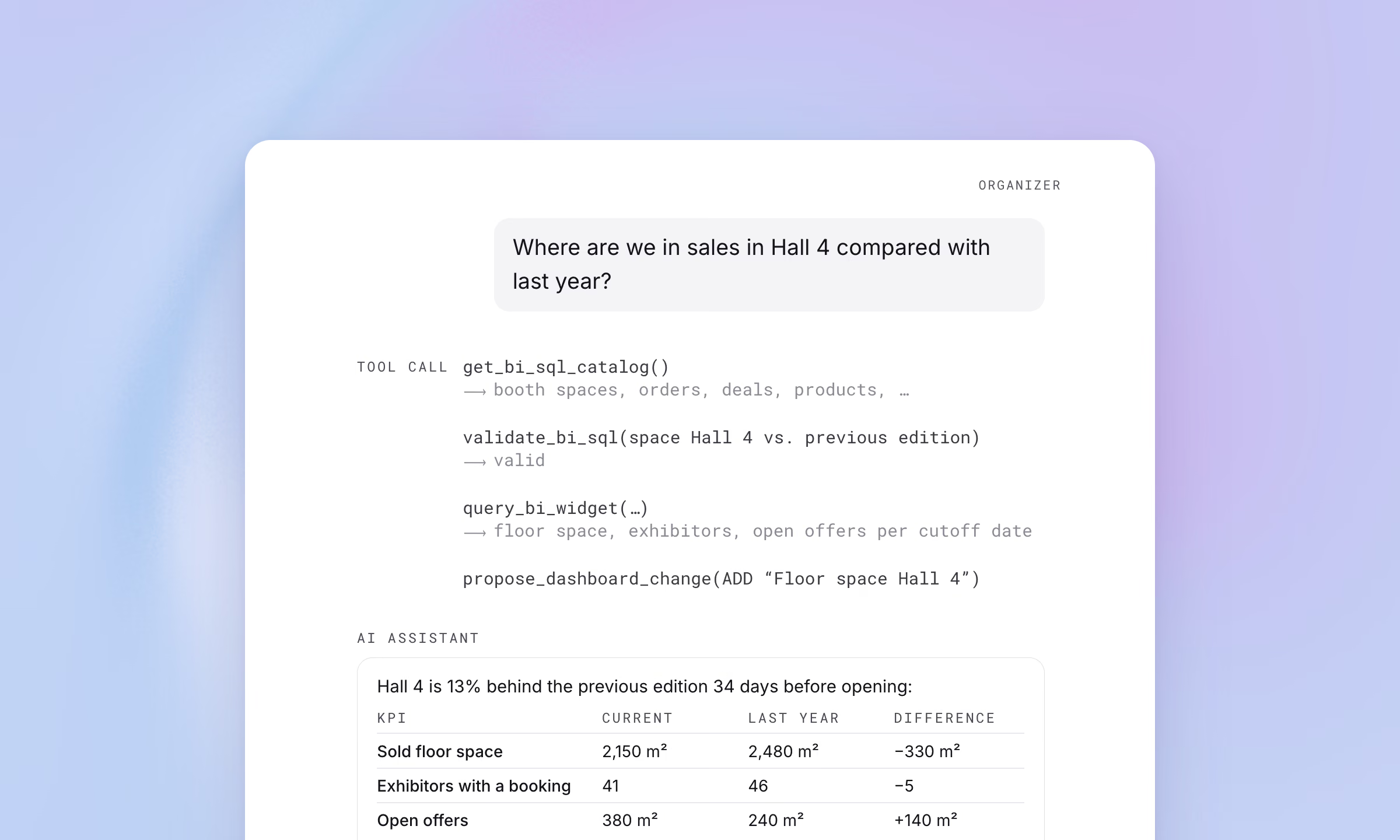
Agents where unstructured requests meet structured systems. Otherwise, mostly deterministic software. The input is unstructured, while context, output and actions are structured. In trade show organization, this applies in two places. In the exhibitor portal, requirements in natural language meet the product catalog, tasks and deadlines; exhibitors know their devices, but rarely the right power connection in the catalog. On the organizer side, a question like “Where are we in sales in Hall 4 compared with last year?” meets a sales data model in which every report requires filters, conditions and comparison periods. In both cases, the model translates the request into structured operations. The system sets the rules.
| Process | Recommendation |
|---|---|
| Deadline checks, reminders | Deterministic software: a clear rule, the same result every time |
| Price calculation, invoices, checkout | Deterministic software: reproducible, auditable, binding |
| Advice on orders, such as the power connection | Agent, recommendation from the guide value table: everyday language is mapped to the catalog |
| Questions about guidelines related to one's own booth | Agent: the rule from the document, its applicability from the booth data |
| Ad hoc analyses in sales | Agent, read-only: filters and comparison period come from the question |
| Standard KPIs | Dashboard with vetted templates: recurring, identical for everyone |
| Placing connections on the booth space | Layout editor, the agent hands over via link: precise to the centimeter and rule-checked |
| Approvals, such as booth height, and hall planning | People: a binding decision, the context lives in people's heads |
What an agent needs: context
The context window covers everything a model sees when it answers: system prompt, conversation history, the definitions of the available tools, tool results and retrieved documents. General knowledge comes from training. About a specific exhibitor, the model only knows what is in the context window. Too little context leads to generic answers or hallucinations. Too much context lowers answer quality and raises cost and latency, because the entire context goes to the model again at every step. Prompt caching dampens cost and latency, but does nothing for answer quality. Chroma measured this effect across 18 models in July 2025 and called it context rot: even a single topically similar but irrelevant passage worsened the result.
Rule to remember: for every step, as much context as necessary and as little as possible. Since 2025, the discipline behind it has increasingly been called context engineering, and Anthropic describes it as the natural progression of prompt engineering. The exact wording of a single input has lost importance, because more capable models need less precise instructions. The system prompt, however, remains part of the context and is itself prompt engineering. Context management is the part that decides at runtime what goes into the context. That includes the choice of tools: every tool definition takes up space in the window, and Anthropic names bloated tool sets as one of the most common mistakes when building agents. The agent therefore only gets the tools it needs on each screen.
Four sources of context
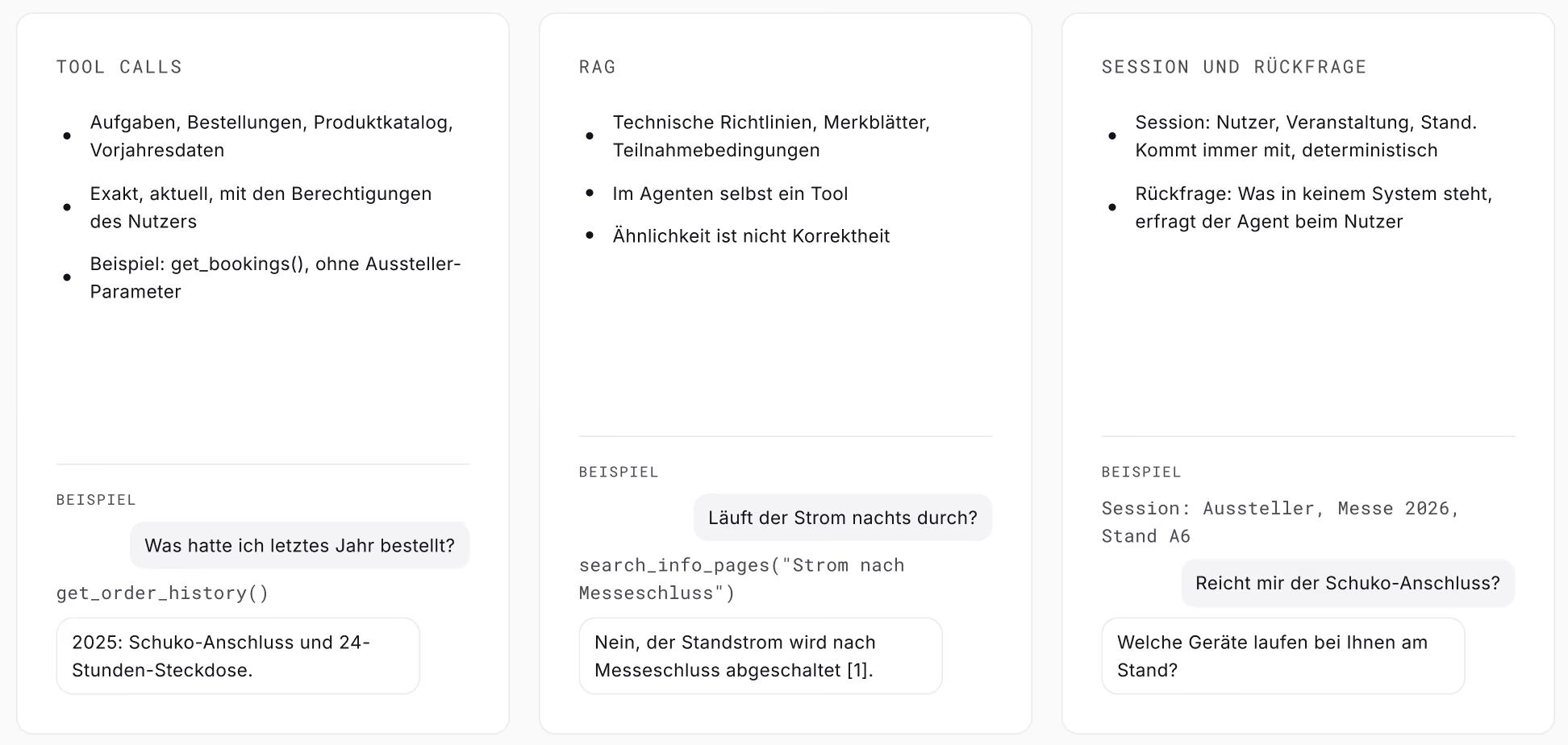
| Source | Provides |
|---|---|
| Tool calls | Structured data from the systems: tasks, orders, catalog, previous-year data. Exact, current, with the permissions of the logged-in person. |
| Document search (RAG) | Passages from technical guidelines, info sheets and terms of participation. The documents are split into sections and indexed; inside the agent, the search itself is a tool. |
| Session | Logged-in person, event, booth. Comes along at every step and stems from the login, not from the model. |
| Follow-up question | Everything that is in no system, such as the devices at the booth. The agent asks instead of making an assumption. |
Similar does not mean correct
A similarity search finds passages that sound like the question. Whether they answer it, the search does not check. Asked “What did I order last year?”, document search returns sections about order deadlines from the info sheet. The right source is the order history, queried via tool call. As a rule: tool calls for answers that live in a data record, document search for answers that live in a text, and both when a rule from a text is applied to specific data. Whether a truss system may stand in Hall 4 requires the permitted height of the booked space and the booked system from the data, plus the approval rule from the guidelines. The approval itself is granted by the organizer and the venue.
Two use cases
As of October 2026: the chat in the Fairoo exhibitor portal is live and is enabled per event; it answers questions from the exhibitor's data with source references. The power connection advice flow is the next development step, and the analytics assistant in the dashboard runs in the test environment. All example data is fictitious.
Exhibitor portal: from a device list to the power connection
The exhibitor wants to know which tasks are still open before the show. The agent fetches them via tool call, without an exhibitor parameter, because the identity comes from the session. The open task is “Power connection”. The exhibitor is unsure whether a Schuko socket or a three-phase connection fits, so the agent loads the catalog and booth data and asks about the devices, since their power draw is in no system. From “a normal office coffee machine, a small fridge, a monitor, two laptops”, the model creates a structured device list. The recommendation does not come from the model, but via tool from the organizer's guide value table: the Schuko connection is enough. The agent proposes two items for the cart, and the order is placed in the regular checkout. It hands the placement of the connection on the booth space over to the layout editor via link. The full flow is shown in the article on how an AI agent recommends the power connection.
Organizer side: from a sentence to a report
The project manager has opened her show's dashboard and asks about the sales status in Hall 4 compared with last year. The agent reads the data catalog and drafts a query; the system checks it for validity and permissions and runs it read-only. The answer compares sold floor space, exhibitors with a booking and open offers at the same distance before opening. On request, the agent adds the KPI to the dashboard, and it is saved after confirmation. Why the comparison only holds at the same cutoff date is explained in the article on the year-over-year comparison in floor space sales.
Read autonomously, change by click
The agent executes read-only tool calls on its own. For every change, it creates a proposal in the form of a button. A person clicks, and the system executes, with the permissions of the logged-in person. The reason lies in the consequences of an error: a wrong read call produces a wrong sentence on the screen, a wrong write call produces a wrong order. Why the model must not be a security boundary, and what the boundary in the system looks like, is covered in the article on securing AI agents.
Five limits of AI agents in trade show organization
| Limit | What helps |
|---|---|
| Hallucination: a plausible but wrong statement when context is missing | Source references, disclosed assumptions, calculations in tools instead of the model |
| Binding decisions: the agent grants no approvals | Approvals stay with organizers, venues and authorities |
| Hall planning: commitments, neighbors and visitor flow live in people's heads | Hall planning stays with people; no agent can fetch context that does not exist |
| Latency and cost: several model calls per answer | Rule-based processes remain deterministic software |
| Data quality: if last year's guidelines are in the index, the agent quotes them | Keep knowledge sources current for each event |
Three questions for every AI offering
- What is in the context window when the model answers?
- Whose permissions do the tool calls run with?
- What does the agent do when context is missing?
Conclusion
Agents do not replace trade show software. They work on top of it. The models are equally available to all vendors, so the quality of an agent is decided by its data foundation: a connected data model across CRM, hall planning, shop, exhibitor portal and invoicing, maintained knowledge sources and tools that run with the permissions of the logged-in person. Fairoo provides this foundation as a platform with a shared database, from the CRM to the exhibitor portal. How booth booking can be automated even without agents is shown in the article Automating booth booking.
Sources
- AUMA and Prognos: Messen im Zeitalter von KI: An der Schwelle zwischen Experiment und Integration (Trade fairs in the age of AI), October 2025, organizer survey 2025/2026 with 123 respondents, in German. auma.de (PDF)
- Simon Willison: I think “agent” may finally have a widely enough agreed upon definition to be useful jargon now, September 18, 2025. simonwillison.net
- Anthropic: Building effective agents, December 19, 2024, and Effective context engineering for AI agents, September 29, 2025. anthropic.com
- Chroma, Kelly Hong, Anton Troynikov and Jeff Huber: Context Rot: How Increasing Input Tokens Impacts LLM Performance, July 14, 2025. trychroma.com
Demo
Book a no-obligation intro call
In a short intro call you'll receive trial access and can walk through a process live using one of your own events, with no commitment.
Frequently asked questions
Where does AI pay off in trade show organization?
Wherever everyday-language requests meet structured systems: when advising exhibitors in the portal and for ad hoc analyses in sales. Deadlines, prices, permissions and calculations are handled faster, cheaper and reproducibly by deterministic software.
Do AI agents replace trade show software?
No. Agents work on top of the software. They need a connected data model, maintained knowledge sources and tools that run with the permissions of the logged-in person. The system defines the process, and the agent simplifies the way through it.
Can an AI agent take over hall planning?
Hall planning stays with people. Which booth stands at the entrance, who is placed next to whom and which commitments apply is rarely in a data record. An agent only works with the context that systems provide.